
The ongoing Ethiopian civil war made headlines at its dramatic inception on November 4th 2020. Tensions came to a head when members of the Tigray People’s Liberation Front (TPLF) – a tribal militia cum political party who had ruled the country until 2016 – surrounded and conquered five of the Ethiopian army’s bases in the north of the country.

Since then, the TPLF has been in a state of war with the national government. After the initial wave of attacks, interest in the Ethiopian conflict has been minimal, sadly, this is to be expected of African affairs, which are often perceived as too complex, and in any case too remote, to be covered in any depth. As far as possible, here is a simplified version of the context for the current conflict:
Ethiopia is an exceptional nation, not only is it among the oldest continual civilisations, but also the only part of the continent that was not colonised during the European “scramble for Africa” through the 19th century.*
A feudal system dominated Ethiopia for much of its history with different tribal groups maintaining a balance of power between them, only uniting under a single leader for the first time in 1855. In the next hundred years, Ethiopia fought off Italian colonisation, outmanoeuvred the British, survived five years of occupation by Benito Mussolini and the same number of famines.
A communist dictatorship known as the Derg seized power in 1973 and brutally oppressed the Ethiopian people for the next quarter-century. Nearly ten years after the collapse of the Soviet Union the Derg was finally overthrown by an alliance of militias known formally as the EPRDF: a coalition group dominated by the TPLF from Tigray in 1998. This is the most direct origin point for the conflict that is unfolding today.
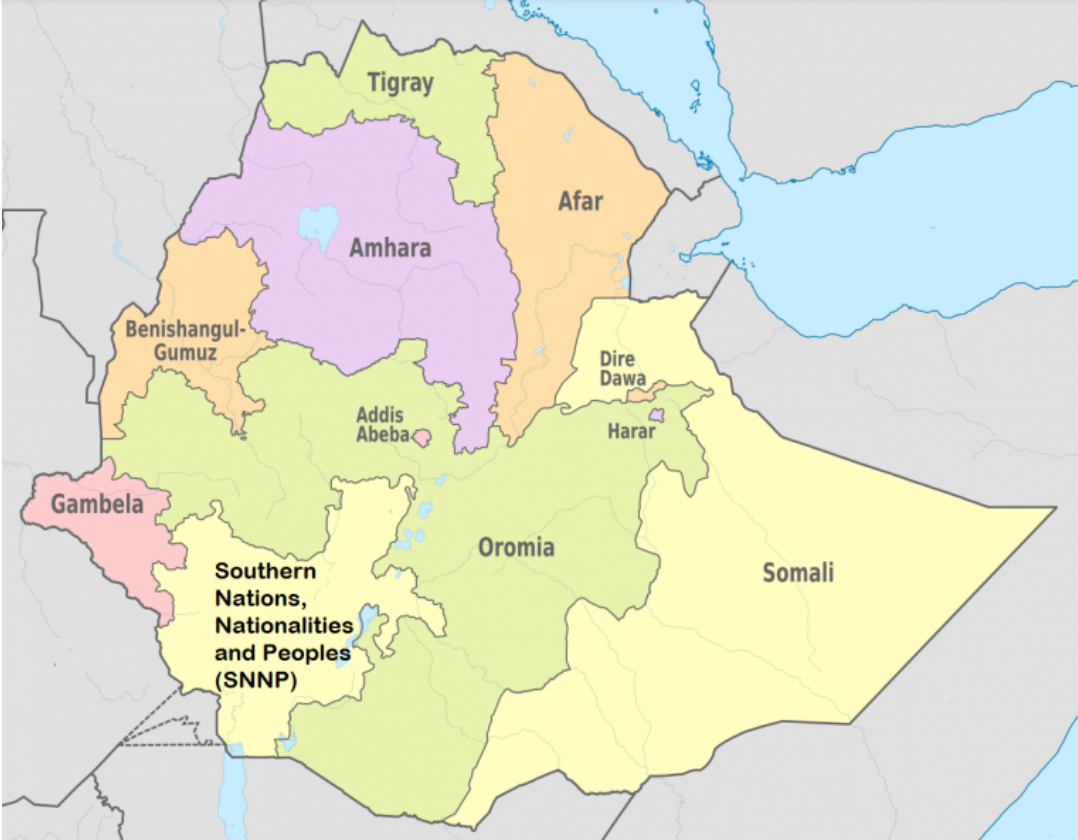
Under TPLF leader Meles Zenawi, Ethiopia transitioned to an “ethnic federation”. An ostensibly democratic system in which all Ethiopians would participate in national government via representatives of their own ethnic groups. On paper, this was to ensure the rights of all “Nations, Nationalities, and peoples” within the country. The reality, however, is that the ethnicisation of Ethiopian politics – and its people – was instituted to legitimise rule by the TPLF. That Tigraens only make up roughly 6% of the country didn’t matter, as the TPLF functioned as the Leninist vanguard of the revolutionary democracy.
In short, Zenawi instituted a government in which democracy was protected by autocracy, and racial equality was maintained by an ethnic hierarchy.
It is not that Ethiopian politics is unique in being driven by ethnic disputes, this can be found across the world. However, it is remarkable that the only “non-colonised” African nation should institute upon itself the kind of identity-driven government that was so often imposed by colonialism as a deliberate divide-and-rule strategy. Nonetheless, Zenawism successfully ensured national rule by the Tigraen elite for thirty years – even if it did have to rig a couple of elections along the way. Notably, the TPLF run government spent its entire existence in a state of war with neighbouring Eritrea which had been part of Ethiopia under communist rule.
TPLF rule came to a dramatic end in 2016. Huge waves of protests from the Amhara and Oromo region, the two largest ethnic territories in the country, finally took power from the TPLF. Abiy Ahmed of the Oromo people became prime minister in 2018. In short order, he dissolved the EPRDF and created instead the “Prosperity Party” furthermore he won a noble peace prize for bringing an end to the war with Eritrea.
Abiy Ahmed’s hope was that the joint power of the Ethiopian and Eritrean armies would be a sufficient threat to scare the TPLF into accepting their loss of power. However, the old government continued to rule Tigray autonomously from the central government. The TPLF’s military wing the Tigraen Defence Forces (TDF) and Ethiopia’s army were preparing themselves for war throughout October 2020 and it was no surprise when conflict broke out at the start of November. The TPLF made the first move, and Abiy Ahmed responded by immediately declaring a military offensive to bring Tigray back under the government’s control.
The ongoing civil war has been exceptionally bloody. In a country governed by ‘ethnic federation,’ all Tigraens are seen by some as guilty of the crimes committed by the TPLF. Noble Peace prize winner Abiy Ahmed’s forces have carried out mass civilian killings that amount to ethnic cleansing. During the first month of the conflict, the national government, joined by Eritrean forces, quickly pushed the TPLF back and conquered the Tigraen capital Mekelle, many saw this as retribution for the years of rule by Tigray’s elite.
Abiy claimed at the end of November that his military campaign was successfully completed. He couldn’t have been more wrong. The TPLF had been driven underground, but the group reorganised itself as a guerilla force and began the work of pushing the national army out of Tigray.
Through the winter of 2020-2021, Abiy’s government has fallen out of favour with the UN as the Ethiopian army begins blocking vital humanitarian aid from entering Tigray. As winter turned to spring the crisis only deepened: crop failures, ethnic cleansing and blockade turned the Tigray region into a disaster zone.
In June, Abiy Ahmed finally held national elections but excluded Tigray from the polling to ensure his victory.
Shortly thereafter the tide of war turned and TPLF forces recaptured the capital Mekelle and promised to drive their enemies out of the greater region. So far, they have been true to their word.
Despite Abiy’s sudden return to lofty pacifism the TPLF has not accepted their offerings of ceasefire and has instead pursued expansion, forming alliances with other ethnic militias close to Tigray and pushing the conflict ever closer to Addis Ababa.
The TPLF is seeking vengeance on the government and those it perceives as supporting it. It will be the latest episode of retributive violence in Ethiopia, but it is unlikely to be the last.
E. Martin
 Aftermath