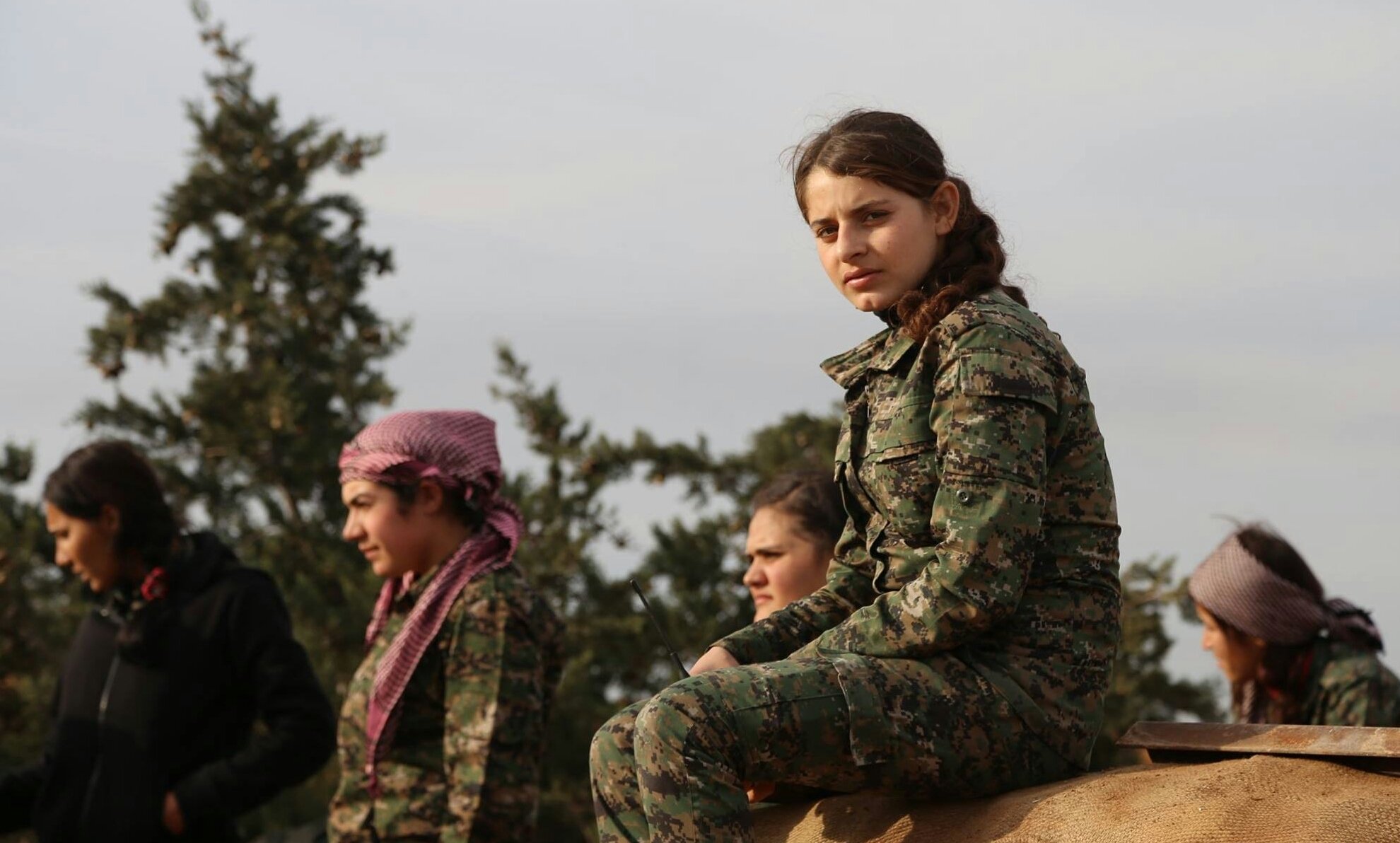
Attribution: Kurdishstruggle, CC BY 2.0 <https://creativecommons.org/licenses/by/2.0>, via Wikimedia Commons
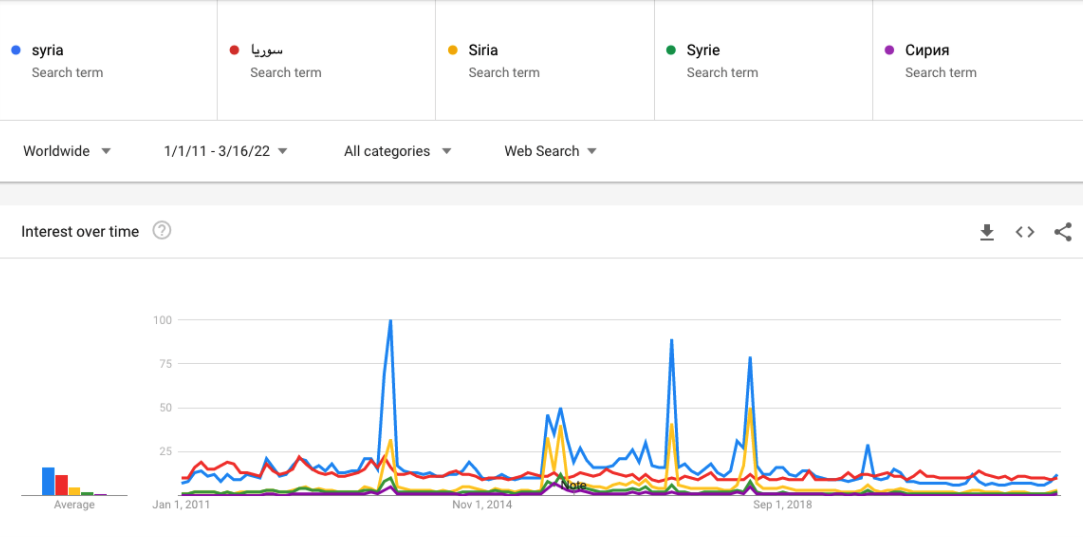
The sad truth is that the world has lost interest in Syria. Its fighting is too complex, its suffering too relentless. The country last received major International attention in 2018 when western forces launched a missile campaign against Assad’s Government. The lack of global interest has provided cover for the Turkish occupation of Northern Syria. This is the relatively untold story of Turkey’s attempt to kill or displace the Kurdish people.
When Civil War broke out in 2011, Syria splintered. The Kurdish majority North, long persecuted by President Assad and his father, began to organise an autonomous administration. Civil society reorganised itself, prioritising secularism, gender equality, local democracy, and freedom from oppressive structures. The autonomous zone became a de facto state, commonly known as Rojava, meaning Western Kurdistan. The civil administration ran hospitals, courts, and even founded a university. An army formed from the need to protect the region from the war which raged to the south. Different defence groups merged under the umbrella name the Syrian Democratic Forces (SDF).
Meanwhile, ISIS too grew, cancer-like, in the ruins of Syria. There they enforced their insidious brand of regressive patriarchal Islamofascism. In response, the SDF became more than a protective organisation, it became the principal Syrian opposition to the caliphate.
Major support came from the United States, which was to be a valuable ally to the Kurdish forces. With American assistance, the SDF captured ISIS’s territories, which folded into Rojava as cities and towns were liberated until there was little left of the Islamic State.

Attribution: Kurdishstruggle, CC BY 2.0 <https://creativecommons.org/licenses/by/2.0>, via Wikimedia Commons
With ISIS members mostly dead or captured, the United States of America saw no need to continue its alliance with the SDF. Trump’s administration felt no loyalty to the men and women who had led the fight. In 2019, the Trump administration gave up the alliance, abandoning the SDF to their fate, and changing the objective in Syria to the securement of oil infrastructure. But it is insufficient to blame Trump, America had always been compromised in Syria: able to train SDF forces to fight ISIS, but not protect them from fellow NATO-member Turkey.
Turkey’s aggression against the Kurds is a continuation of a longer conflict. Kurds are a minority ethnic group in Turkey, Syria, Iraq and Iran. They have their own languages and culture, and many seek autonomy from the Turkish state. In the late 1970s, a Marxist-Leninist group emerged known as the Kurdish Workers’ Party (PKK) it engaged in direct conflict with the government. The PKK is designated a terrorist group by Turkey, the EU and USA. The Turkish government is afraid of any Kurdish organisations and believes them all to be fronts for the PKK. President Erdoğan and his government believe the Syrian Democratic Forces are in fact the same terrorists it has been fighting for decades.
Turkey exerts its control in Syria through a group of rebels once known as the “Free Syrian Army” which now go by the misleading name the “Syrian National Army”. They may once have been an ideological resistance to President Assad, but the group is now a fractured mercenary organisation, united only in the receipt of Turkish money. For consistency, this article will refer to them as the TFSA (Turkish backed Free Syrian Army)
Operating alongside Turkey’s official armed forces, the TFSA has led three major operations into Northern Syria since 2016. The permissive rationale of “combatting terrorism” has allowed Turkey to attack ISIS and Rojava alike. Each time forcing the mass displacement of Kurdish people, then, Turkey moves Arab and Turkmen refugees into these areas. Effectively, Turkey is able to pursue ethnic engineering beyond its borders and call it a joint counterterrorism and refugee resettlement operation. The TFSA has been consistently accused of egregious human rights violations in its effort to ethnically cleanse Rojava of the Kurds.
August 2016 – March 2017 “Operation Euphrates Shield”
This was the first offensive by Erdoğan’s forces alongside the TFSA. The advancement of Turkish forces established a foothold in Northern Syria, principally the border town of Jarablus, and several other settlements near Aleppo. Turkey claims to have been fighting both the SDF and ISIS. However, the TFSA, which contains many Islamist factions, would not work with American forces against Islamic State. The major victory for Turkey was preventing the SDF from connecting two major sections of Rojava. TFSA soldiers then shared pictures of themselves torturing SDF prisoners of war.
January 2018 – March 2018 “Operation Olive Branch”
Erdoğan used the same counterterrorism rhetoric to justify a major offensive against the city of Afrin. It was here that the worst crimes of the invasion were committed, here that the case against Turkey is clearest. Research by the Ceasefire Centre for Civilian Rights documents the cruel irony of Turkey’s “Olive Branch”. The full, damning, report is accessible here.
As they had in much of Kurdish majority Syria, the people of Afrin had taken the civil war as an opportunity to develop means of self-government, declaring autonomy as part of Rojava in 2014. For four years Afrin became a safe haven for a further 100,000 Syrians from across the country, all while developing civil institutions, democratic and equal ways of life, and building its first university.
In just three months this all collapsed. The Turkish airforce led with airstrikes carving a route into the city, bombing both military and civilian targets, resulting in hundreds of civilian casualties. The campaign was indiscriminate, and war crimes were common, such as this one listed in the Ceasefire report:
“On 5 March 2018, near the Berband (Berbenê) village junction in Rajo, Turkish aircraft bombed a bus full of civilians fleeing the military operations in the countryside. The bus was struck three times consecutively, killing between 2 and 7 people. The dead included an elderly woman in her 90s and an 8-year-old child. Many of the others on board the bus were injured, including several children.”
The bombing campaign included the destruction of a hospital, several schools, the university, and a mosque, where residents had been sheltering in the belief that Turkish forces would not target a place of worship.

Attribution: Voice of America Kurdish, Public domain, via Wikimedia Commons
On the ground, TFSA forces surrounded, enclosed, and eventually captured Afrin. The Autonomous Administration was forced to flee, in its place was built new Turkey-loyal infrastructure. This government vastly underrepresents women and Kurds. Torture, abductions, and disappearances of anyone suspected of opposing the new government have been common, orchestrated by the TFSA militia groups. 300,000 people were displaced from Afrin and the surrounding area. Turkish authorities immediately set to work moving Turkmen and Arabs into what remained of their homes, some of the new residents are refugees, others are TFSA claiming their spoils.
October 2019 – November 2019 “Operation Peace Spring”
Throughout 2019 Ankara had been in talks with Washington regarding the creation of a new “safe-zone” in Northern Syria, the familiar rationale “counterterrorism and refugee settlement” was given, but Trump’s administration appeared to be holding back Turkish encroachment. This was the situation when American troops were suddenly ordered to withdraw from Rojava. Effectively, the United States gave its blessing to a Turkish invasion, which is exactly what happened. “Operation Peace Spring” was a rapid movement of Turkish forces across the Syrian border. In ten days a strip of land 120km wide and 30km deep was claimed, controlling the key towns of Tel Abyad and Ras Al-Ayn.
A flurry of diplomacy bought a cease-fire ten days later, and with it, the acceptance of a huge loss of Rojava, and a protective barrier built between Turkey and the Kurds.
Amnesty International has stated that there is evidence of war crimes committed by the TFSA during this operation. The evidence suggests a repeat of similar crimes to those committed in Afrin. According to the organisation, there is
“damning evidence of indiscriminate attacks in residential areas, including attacks on a home, a bakery and a school, carried out by Turkey and allied Syrian armed groups. It also reveals gruesome details of a summary killing in cold blood of a prominent Syrian-Kurdish female politician, Hevrin Khalaf [by the TSFA]”
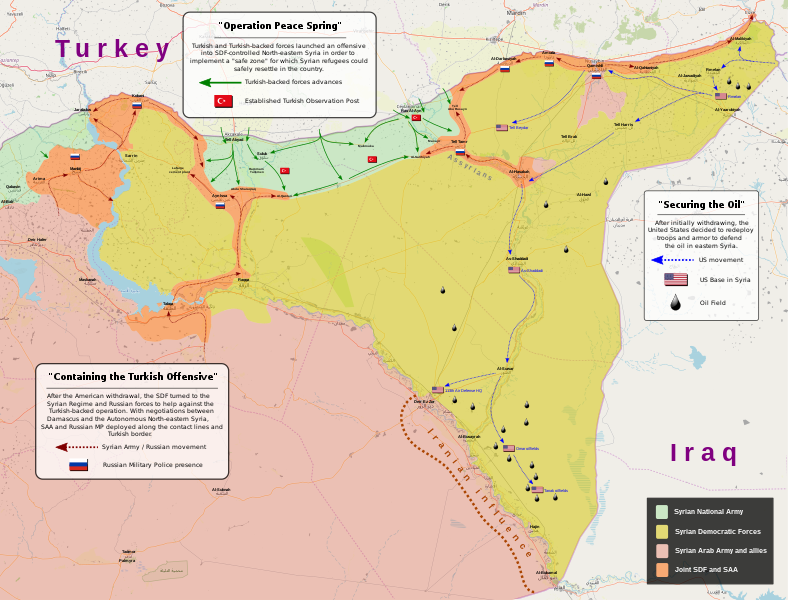
Turkish occupation in Green.
Since the offensives, the Biden administration has turned toward a more nebulous counterterrorism and humanitarian objective within Syria but has not reforged the alliance with the SDF. Instead, the last desperate hope for Rojava has been Assad, their historical enemy. It shows just how dire the situation is that any form of autonomy for Rojava’s people is now dependent on the Syrian dictator.
Inside Turkish controlled “safe zones” SDF forces continue to wage a guerrilla insurgency, this has so far been unsuccessful in dislodging the occupying force. There are many reports of terror attacks that Turkey is quick to blame on the SDF, but may also be the work of latent Islamist groups who sometimes take credit. The TFSA has maintained a reign of fear over the citizens of its “safe” zones.
For now, the SDF has managed to secure their lands by enlisting Assad’s aid in holding back the Turkish advancement. Using one enemy to fight another might function as a short term strategy, but how long can it last when they are both fighting over what remains of Rojava?
E. Martin
 Aftermath
.svg)